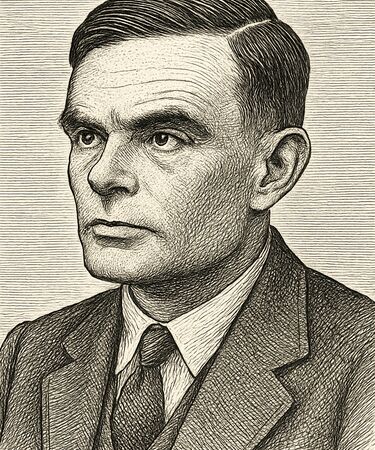
Alan Turing (1912–1954) provided the theoretical soul of the computing age. In 1936, his paper On Computable Numbers conceptualised the “Universal Machine” — a device capable of performing any logical task if given the right instructions.
During the war, he industrialised the code-breaking process at Bletchley Park. He saw the computer as a “universal mind,” leading to his work on the ACE (Automatic Computing Engine) and early inquiries into artificial intelligence. Turing’s genius was in seeing that a machine was not just a calculator, but a flexible vessel for software. His legacy defines the modern world.