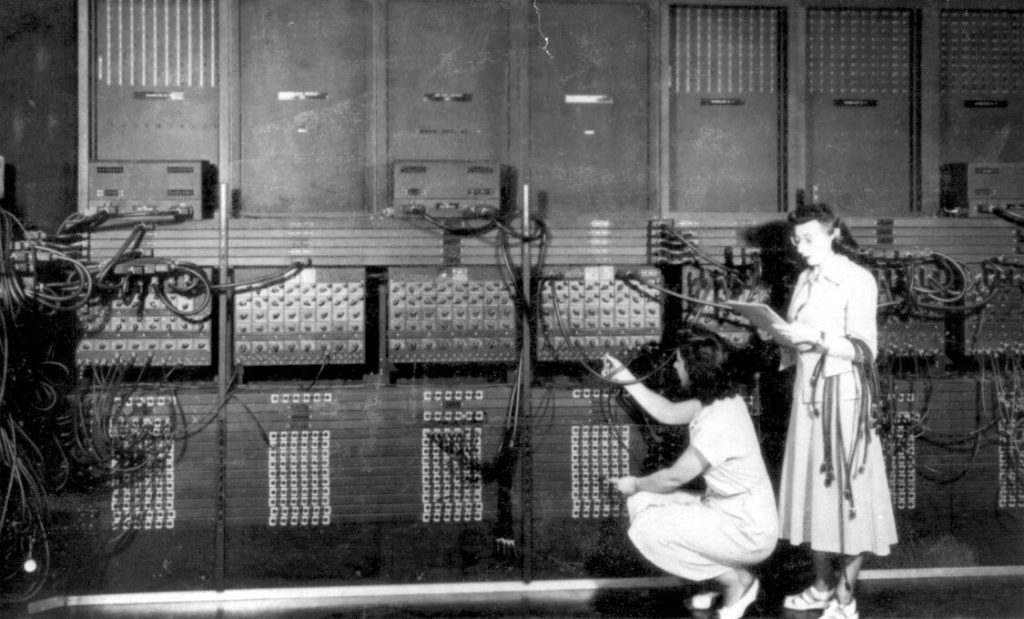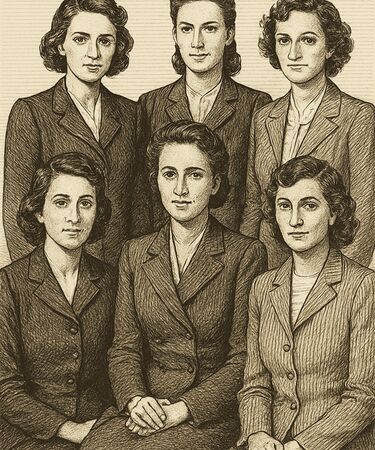
Kay McNulty (1921–2006), Betty Jennings (1924–2011), Marlyn Wescoff (1922–2008), Ruth Lichterman (1924–1986), Frances Bilas (1922–2012) and Betty Holberton (1917–2001) were the world’s first programmers. While history has long celebrated the men who built the ENIAC’s hardware, the task of making the thirty-ton machine actually “compute” fell to six female mathematical pioneers.
Originally hired as “human computers” to calculate ballistics tables by hand, they were selected from a wartime corps of nearly 200 women to become the world’s first professional programmers. In a pre-von Neumann world with no manuals or languages, they mastered the machine’s internal logic by crawling through its massive frame to manipulate hundreds of cables and switches. They were essentially building the program through physical architecture. Despite being dismissed in contemporary press photos as “refrigerator ladies”, they were the architects of software. They proved that the brilliance of the ENIAC lay in the human instructions that allowed it to think rather than its 17,000 glowing tubes.
Between 1942 and 1945, the US Army’s Ballistic Research Laboratory (BRL) recruited a corps of mathematical talent that eventually grew to nearly 200 women. These “Human Computers” came from colleges across America to solve complex differential equations required for artillery firing tables — work that was a matter of life and death on the front lines. They built the program’s logic through physical architecture; if a single wire was misplaced, the “giant brain” became a useless collection of glowing glass.
They proved that its brilliance lived not just in its vacuum tubes, but in the human mind’s ability to translate complex physics into binary. By the time the ENIAC was unveiled in February 1946, it had been transformed from a static calculator into a flexible, universal tool, setting the template for every programmer who followed.